
 Eurovision News

The Eurovision Song Contest has come a remarkably long way since seven countries gathered at the Teatro Kursaal in Lugano, Switzerland, on 24 May 1956 for the very first contest. Seventy years later, Eurovision has become one of the world’s biggest annual television events, and its history can be traced through an ever-expanding collection of host cities across Europe.
By the end of Eurovision 2026, the contest will have been staged in 46 different cities across 26 countries, with some cities returning to host the event multiple times. Vienna’s 2026 edition was the 70th Eurovision Song Contest and marked the Austrian capital’s third time as host, following 1967 and 2015.
But the numbers are about to change.
Following DARA’s victory for Bulgaria in Vienna in 2026, Eurovision is heading to Bulgaria for the first time in 2027. It will be the 71st Eurovision Song Contest and Bulgaria’s first opportunity to host the competition.
The only remaining question is where.
Bulgaria joins the Eurovision host nation club
Bulgaria made its Eurovision debut relatively recently, in 2005, and for many years hosting the contest seemed a distant prospect. That changed dramatically when DARA won Eurovision 2026 with Bangaranga, giving Bulgaria its first Eurovision victory.
The victory immediately set in motion preparations for Eurovision 2027. Four Bulgarian cities initially expressed an interest in hosting: Sofia, Burgas, Plovdiv and Varna. Following the first stage of the selection process, however, Plovdiv and Varna were eliminated, leaving Sofia and Burgas as the two finalists.
Consequently, 2027 will be significant in Eurovision history in two ways. Bulgaria will become the 27th country to host the Eurovision Song Contest, while whichever city is selected will become the 47th individual host city.
The distinction is important because Eurovision has never required the winning country to stage the contest in its capital. Indeed, a substantial part of Eurovision’s history has taken place outside national capitals. The EBU has noted that 23 European capitals had hosted by the time of its 2025 overview, representing only about half of the 46 cities that had hosted the contest.
That makes the current Sofia-versus-Burgas contest particularly interesting.
Sofia would give Bulgaria the traditional capital-city Eurovision experience. The capital has extensive international transport links, hotels, media infrastructure and previous experience with large-scale international events.
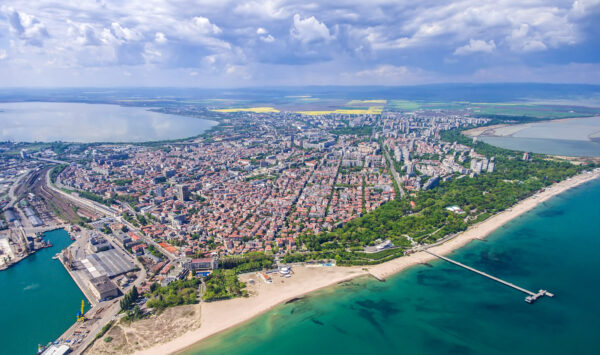
Burgas, meanwhile, would continue Eurovision’s long tradition of taking the contest beyond capitals. The Black Sea city is hoping to use its modern infrastructure, tourism appeal and new arena to provide a distinctive setting for the 2027 contest. The EBU confirmed in July that the two cities had progressed to the final stage of the selection process.
As of 12 August 2026, the final choice between Burgas and Sofia had not yet been announced, so either city would represent a new addition to Eurovision’s host-city map.
A history of 46 host cities
The first Eurovision was deliberately small. Lugano hosted seven participating countries in 1956, and the contest remained relatively intimate during its first decade. It was not until 1958 that the tradition of the previous year’s winning country hosting the following contest became established.
The contest subsequently travelled around Europe, visiting capitals such as London, Paris, Rome, Stockholm, Oslo, Athens, Lisbon, Kyiv, Riga, Tallinn, Moscow, The Hague, Vienna and Madrid, but also smaller or less obvious host locations including Millstreet( Ireland), Harrogate (England), Brighton, Bergen and Düsseldorf.
Dublin has been one of Eurovision’s most important host cities. It has hosted the contest six times, more than any other city. Followed by London and Luxembourg City which have hosted four times, while Copenhagen, Malmö, Stockholm and Vienna have each hosted three times. Vienna’s third hosting came in 2026.
Some cities have also hosted under very different political circumstances. Zagreb hosted Eurovision in 1990 when it was part of Yugoslavia; Belgrade later hosted in 2008 as the capital of Serbia. Kyiv has hosted twice for Ukraine, while Jerusalem has hosted twice for Israel.
The result is a fascinating geographical record stretching from Switzerland in 1956 to Austria in 2026 — and now, in 2027, to Bulgaria.
Every Eurovision host city, 1956–2026
The table below lists every Eurovision Song Contest edition that has actually taken place. Eurovision 2020 in Rotterdam is included as a cancelled edition for completeness, but it did not have a live contest, following the cancellation caused by the COVID-19 pandemic. Rotterdam subsequently hosted the contest in 2021.
| Year | Host city | Host country |
|---|---|---|
| 1956 | Lugano | Switzerland |
| 1957 | Frankfurt | West Germany |
| 1958 | Hilversum | Netherlands |
| 1959 | Cannes | France |
| 1960 | London | United Kingdom |
| 1961 | Cannes | France |
| 1962 | Luxembourg City | Luxembourg |
| 1963 | London | United Kingdom |
| 1964 | Copenhagen | Denmark |
| 1965 | Naples | Italy |
| 1966 | Luxembourg City | Luxembourg |
| 1967 | Vienna | Austria |
| 1968 | London | United Kingdom |
| 1969 | Madrid | Spain |
| 1970 | Amsterdam | Netherlands |
| 1971 | Dublin | Ireland |
| 1972 | Edinburgh | United Kingdom |
| 1973 | Luxembourg City | Luxembourg |
| 1974 | Brighton | United Kingdom |
| 1975 | Stockholm | Sweden |
| 1976 | The Hague | Netherlands |
| 1977 | London | United Kingdom |
| 1978 | Paris | France |
| 1979 | Jerusalem | Israel |
| 1980 | The Hague | Netherlands |
| 1981 | Dublin | Ireland |
| 1982 | Harrogate | United Kingdom |
| 1983 | Munich | West Germany |
| 1984 | Luxembourg City | Luxembourg |
| 1985 | Gothenburg | Sweden |
| 1986 | Bergen | Norway |
| 1987 | Brussels | Belgium |
| 1988 | Dublin | Ireland |
| 1989 | Lausanne | Switzerland |
| 1990 | Zagreb | Yugoslavia |
| 1991 | Rome | Italy |
| 1992 | Malmö | Sweden |
| 1993 | Millstreet | Ireland |
| 1994 | Dublin | Ireland |
| 1995 | Dublin | Ireland |
| 1996 | Oslo | Norway |
| 1997 | Dublin | Ireland |
| 1998 | Birmingham | United Kingdom |
| 1999 | Jerusalem | Israel |
| 2000 | Stockholm | Sweden |
| 2001 | Copenhagen | Denmark |
| 2002 | Tallinn | Estonia |
| 2003 | Riga | Latvia |
| 2004 | Istanbul | Turkey |
| 2005 | Kyiv | Ukraine |
| 2006 | Athens | Greece |
| 2007 | Helsinki | Finland |
| 2008 | Belgrade | Serbia |
| 2009 | Moscow | Russia |
| 2010 | Oslo | Norway |
| 2011 | Düsseldorf | Germany |
| 2012 | Baku | Azerbaijan |
| 2013 | Malmö | Sweden |
| 2014 | Copenhagen | Denmark |
| 2015 | Vienna | Austria |
| 2016 | Stockholm | Sweden |
| 2017 | Kyiv | Ukraine |
| 2018 | Lisbon | Portugal |
| 2019 | Tel Aviv | Israel |
| 2020 | Rotterdam* | Netherlands |
| 2021 | Rotterdam | Netherlands |
| 2022 | Turin | Italy |
| 2023 | Liverpool | United Kingdom |
| 2024 | Malmö | Sweden |
| 2025 | Basel | Switzerland |
| 2026 | Vienna | Austria |
| 2027 | Burgas or Sofia | Bulgaria |
The 2020 contest was cancelled and therefore did not take place as a live Eurovision Song Contest. Rotterdam nevertheless remained the designated host city and subsequently staged Eurovision in 2021.
The historical host-city record is consistent with the EBU’s overview of Eurovision’s locations, which identifies Lugano as the first host city and notes that 46 cities had hosted by the 2026 contest.
Which countries have hosted Eurovision?
Through 2026, 26 countries have hosted the Eurovision Song Contest if historical host countries are counted according to the political entity under which the contest was staged.
They are:
| No. | Country | First hosted | Host cities |
| 1 | Switzerland | 1956 | Lugano, Lausanne, Basel |
| 2 | West Germany / Germany | 1957 | Frankfurt, Munich, Düsseldorf |
| 3 | Netherlands | 1958 | Hilversum, Amsterdam, The Hague, Rotterdam |
| 4 | France | 1959 | Cannes, Paris |
| 5 | United Kingdom | 1960 | London, Edinburgh, Brighton, Harrogate, Birmingham, Liverpool |
| 6 | Luxembourg | 1962 | Luxembourg City |
| 7 | Denmark | 1964 | Copenhagen |
| 8 | Italy | 1965 | Naples, Rome, Turin |
| 9 | Austria | 1967 | Vienna |
| 10 | Spain | 1969 | Madrid |
| 11 | Ireland | 1971 | Dublin, Millstreet |
| 12 | Sweden | 1975 | Stockholm, Gothenburg, Malmö |
| 13 | Israel | 1979 | Jerusalem, Tel Aviv |
| 14 | Norway | 1986 | Bergen, Oslo |
| 15 | Belgium | 1987 | Brussels |
| 16 | Yugoslavia | 1990 | Zagreb |
| 17 | Estonia | 2002 | Tallinn |
| 18 | Latvia | 2003 | Riga |
| 19 | Turkey | 2004 | Istanbul |
| 20 | Ukraine | 2005 | Kyiv |
| 21 | Greece | 2006 | Athens |
| 22 | Finland | 2007 | Helsinki |
| 23 | Serbia | 2008 | Belgrade |
| 24 | Russia | 2009 | Moscow |
| 25 | Azerbaijan | 2012 | Baku |
| 26 | Portugal | 2018 | Lisbon |
| 27 | Bulgaria | 2027 | Burgas or Sofia |
There is a small historical caveat here: West Germany and Yugoslavia were the countries that hosted in their respective years, whereas modern Germany and Croatia are their successor states. For a straightforward count of Eurovision’s historical host countries, they are best treated as separate historical entities rather than retroactively rewriting the political geography of the period.
The Eurovision map keeps expanding
One of the most striking features of Eurovision’s history is how often the competition has ventured beyond the obvious choice of a national capital.
Many a time the Eurovision Song Contest has travelled to other cities rather than the capital city itself: Millstreet, Basel, Lugano, Lausanne, Bergen, Gothenburg, Harrogate, Liverpool, Turin, Naples, Cannes, Dusseldorf, Munich, Frankfurt, Brighton, Rotterdam, Hilversum, Amsterdam etc.
The same is true of recent contests. Liverpool hosted in 2023 on behalf of Ukraine, despite the United Kingdom not being the previous year’s winner. Malmö followed in 2024, Basel in 2025 and Vienna in 2026. Vienna’s selection was particularly fitting for the 70th anniversary, as the city had already hosted Eurovision in 1967 and 2015.
Now Bulgaria has the opportunity to add its own chapter.
If Sofia is selected, Eurovision will visit another major European capital and Bulgaria’s largest city. If Burgas wins, Eurovision will add a new Black Sea destination to its list of host cities and continue the tradition of taking the competition to places outside capitals.
Either way, the mathematics of Eurovision history will change in 2027:
- 27 countries will have hosted the Eurovision Song Contest.
- 47 cities will have hosted the contest.
- Bulgaria will become the newest host nation.
- Burgas or Sofia will become Eurovision’s newest host city.
- The 2027 contest will be the 71st edition of Eurovision.
From seven broadcasters in Lugano in 1956 to a truly continental television phenomenon in 2026, Eurovision’s host-city history is almost a history of Europe itself. The addition of Bulgaria in 2027 will be another milestone — and, depending on the final decision, either Sofia or Burgas will become the latest city to put its name alongside London, Dublin, Stockholm, Malmö, Vienna and the other great Eurovision host cities.
The EBU and BNT are expected to unveil the Eurovision 2027 Host City in due course, with the announcement imminent!